When drivers want the high score

Scorecards, rankings, and rewards. When drivers can see their score, they compete to improve it.

Culture
Scorecards turn abstract safety talk into a number every driver owns.
Objective scores from real driving behavior, updated automatically.
Sites, shifts, and regions race each other to the top.
Celebrate improvement, not just perfection.
Gamified fleets hold gains long after the launch month.
What Changes
What the top tier is worth. Platinum-status drivers show 48% lower collision risk, benchmarked against Geotab's 9M+ connected drivers (Geotab Vitality Playbook, 2026).
Vitality
Geotab Vitality is a driver-rewards platform built on behavioral science and Geotab's predictive collision-risk data.
Drivers get weekly safety goals, climb tiers, and earn rewards, all as a MyGeotab Add-In on your existing GO devices: no new hardware, no cameras.
Because rewards coach every driver, not just the bottom of the leaderboard, Vitality fleets see average predicted collision risk fall by about 8% fleet-wide (Geotab Vitality Playbook, 2026).
Vitality offers a free pilot for up to 20 drivers for 60 days with no commitment. Practical requirements: GO devices with driver assignment in place, drivers logging at least 30 miles a week, and 2 to 4 weeks of calibration for fleets new to Geotab.
We handle the setup and enrollment alongside your safety lead.
The reported numbers. Geotab reports high-risk events down 22-48% within 60 days, fuel efficiency up 2-4%, and turnover down up to 44% (Geotab-reported, vendor figures). The pilot is how you get your own.

In The Driver's App
It all happens on the driver's phone between stops. Drivers watch their streaks; you watch the trend.
A closer look
Scoring, rankings, and rewards all run on the GO device data your fleet already collects.
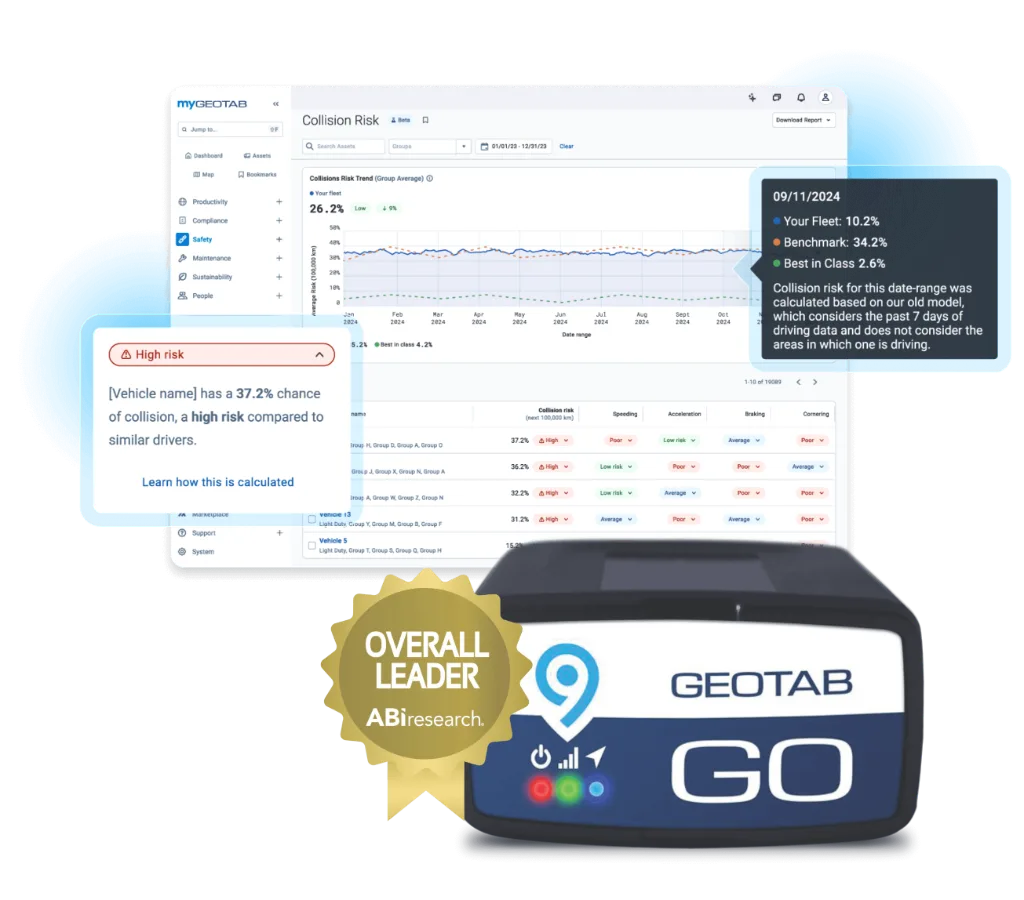
Every driving event is weighted by collision risk, so a driver's score reflects real risk, not just a list of infractions.
Rankings by team, route, or region that drivers actually check.
Drivers see their own number without asking a manager.
Improvement is visible week over week, not just at review time.
The numbers behind every reward, so recognition lands as earned, not political.
Show leadership the competition is moving the fleet number.
One Score Per Driver

Camera and GO events roll into one score per driver, ready for the leaderboard on the breakroom screen.
Questions
Scorecards, benchmarks, and recognition motivate drivers to improve the behaviors that reduce risk.
Speeding, harsh braking and acceleration, cornering, idling, and seatbelt use, among others.
Yes. Rankings and rewards give drivers a clear, positive reason to keep improving.
Almost nothing in labor: goals, scoring, nudges, and reward fulfillment are automated inside the add-in. Managers watch a dashboard; drivers manage themselves.
Scoring uses Geotab's predictive collision-risk model, calibrated by vehicle type and operating context, so a delivery van downtown is not graded against a highway tractor.
Yes, participation is voluntary, which is exactly why it works in union shops. One municipal example: King Township, Ontario ran a 21-driver union program that cut predicted collision risk 7% and improved fuel efficiency 6.4%, with zero grievances (Geotab Vitality case studies, 2026).
Fleets typically see measurable behavior change within about six weeks. The free Vitality pilot exists so your own numbers, not our reported ones, settle the question.
Keep exploring
We will help you design scorecards and rewards that fit your crew during a free demo.